Moving cuttings from water to soil is the step where many healthy-looking cuttings stall or collapse. That usually isn’t bad luck. The roots grew in one environment and suddenly have to work in another, and the first couple of weeks decide whether they adapt. This guide covers when to pot up, how to plant water roots without breaking them, and how to water afterwards. It is part of our water, soil and LECA transitions hub.
Short version: Pot up when roots are about 1–2 in (2.5–5 cm) long. Use a small pot with a drainage hole and an open, pre-moistened potting mix. Firm gently, water through, and keep the mix evenly moist (never soggy) for the first one to two weeks. Hold the fertilizer until the plant is growing.
Why water-rooted cuttings struggle in soil
Roots that form in water are not quite the same as roots that form in a solid medium. University of Minnesota Extension notes that roots grown in water are weaker than those grown in a solid rooting medium. Virginia Tech adds that water-formed roots suffer more transplant shock when they move to soil.
So a freshly potted cutting faces two opposite risks:
- Drying out. Roots used to sitting in water lose contact with moisture when the mix dries quickly.
- Drowning. Overcorrecting with soggy mix in an oversized pot leaves those same roots without air.
Everything below is about steering between those two.
Moving cuttings from water to soil: when to pot up
Root length is the most common question, and advice online ranges from “as soon as you see a root” to “wait for a full jar.” The institutional sources cluster around a sensible middle:
| Source | When they say to pot up |
|---|---|
| UW Botanic Gardens’ Miller Library | When roots are 1–2 inches long |
| Maryland Grows (University of Maryland Extension) | Once roots form, let them grow another 1–2 weeks, then plant |
| RHS | Cuttings typically root in 3–4 weeks; pot them individually into 8–10 cm pots |
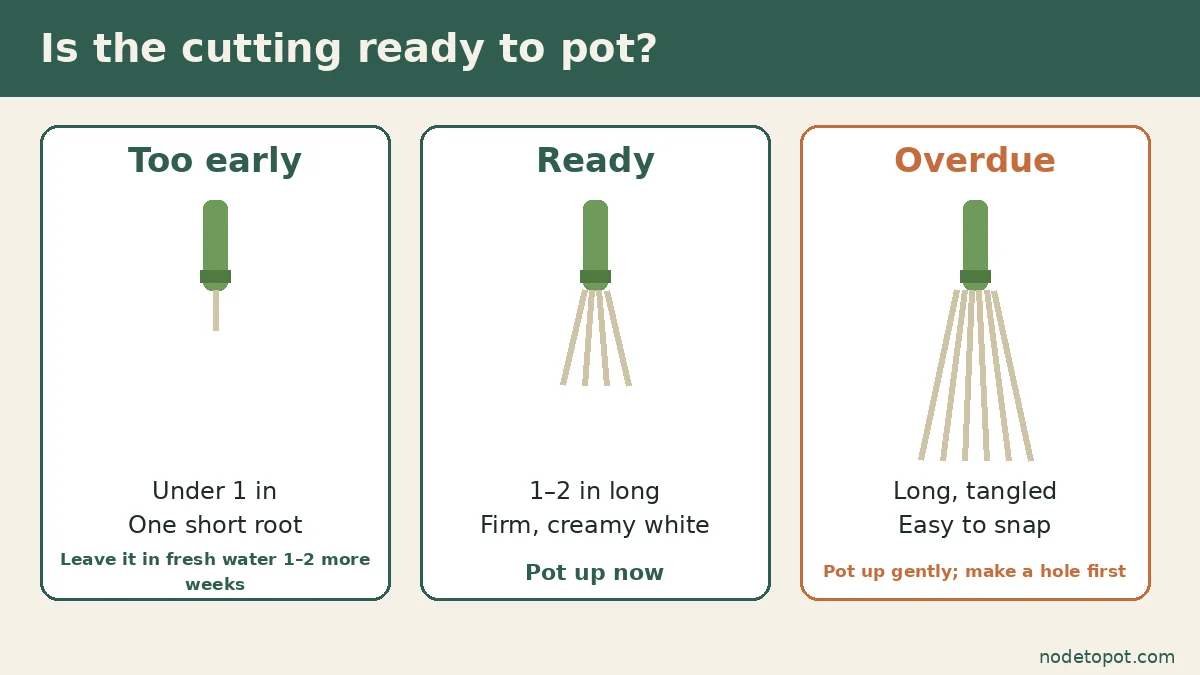
A practical rule follows from that: pot up at 1–2 in (2.5–5 cm) of firm, pale root, and don’t wait for a tangle. Very long water roots are the ones most easily snapped while planting.
The readiness check
Before you reach for the potting mix, look at the cutting itself:
| What you see | What it means | What to do |
|---|---|---|
| Several firm, creamy white roots, 1–2 in (2.5–5 cm) | Ready | Pot up now |
| One short root, under 1 in | Early | Leave it in fresh water another week or two |
| Long roots wrapped around the jar | Overdue | Pot up carefully; don’t force roots into a tight hole |
| Brown, soft or slimy roots; cloudy or smelly water | A rot problem, not a timing problem | Fix the rot first (see our problems hub) |
UMN describes healthy roots as creamy white and firm. Brown, soft roots point to rot, and potting them up won’t fix it.
Keep the cutting healthy while you wait
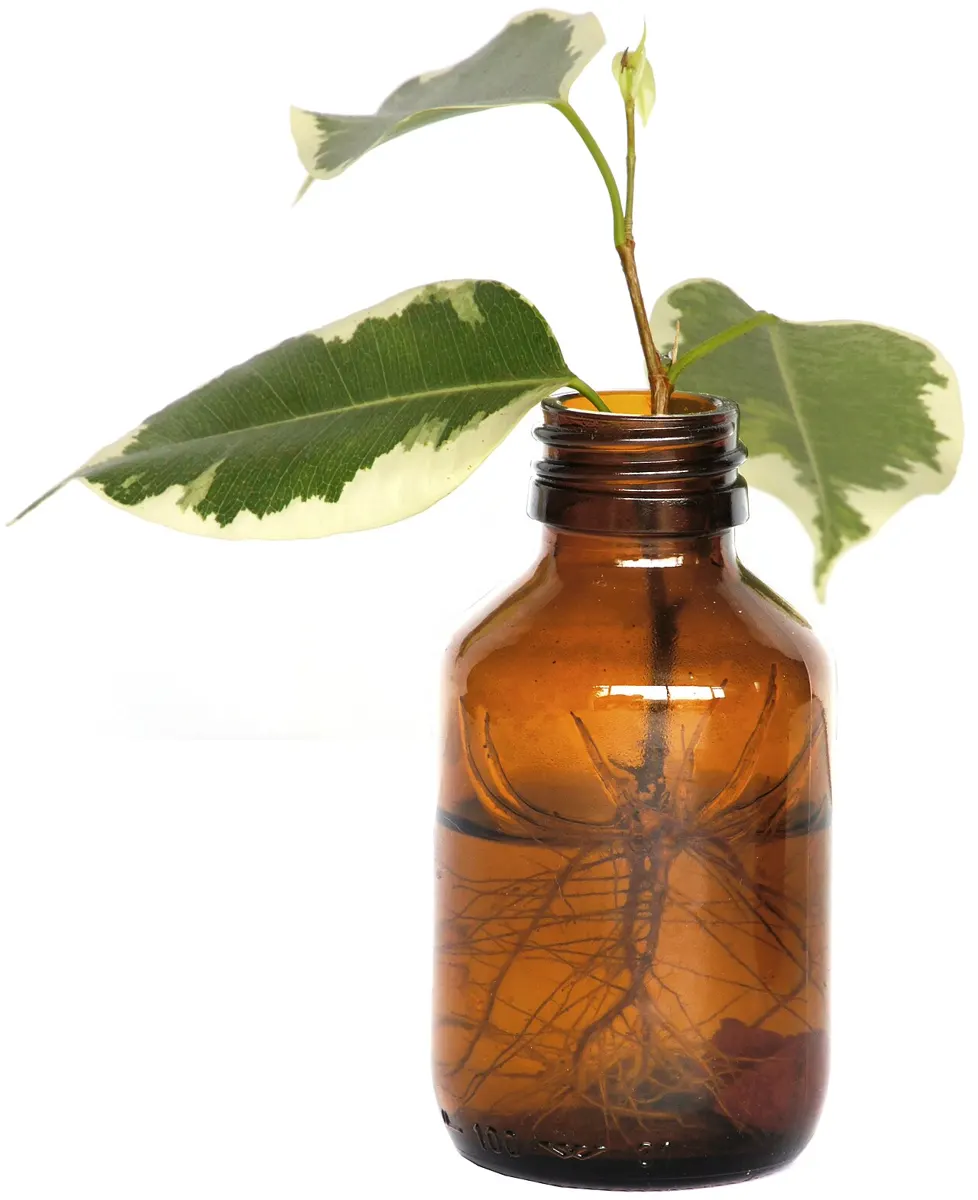
A clean jar makes for better roots to transplant. Maryland Grows recommends changing the water at least twice a week and keeping cuttings around 70°F (21°C). Virginia Tech says to change it at least weekly and suggests 70–75°F for rooting. The Missouri Botanical Garden suggests topping up with fresh water as the level drops, and notes that a stub of stem left below the node often rots, so trim it back.
What you need
- A small pot with a drainage hole. The RHS suggests pots about 8–10 cm (roughly 3–4 in) wide for individual rooted cuttings. A pot that is too big holds wet mix around a small root system.
- An open, free-draining potting mix. The Miller Library recommends an open mix rather than dense soil.
- Water and a sink or tray so the pot can drain.
- Optional: a heat mat, which the Miller Library suggests for keeping new cuttings around 70°F in a cool room.
How to pot up a water-rooted cutting, step by step
- Pre-moisten the mix. Add water a little at a time until it is damp but not soggy. Bone-dry mix pulls water away from roots that have never dried out.
- Add a layer of mix to the pot so the base of the cutting will sit a little below the rim.
- Make a hole first. Open a space with a finger or pencil rather than pushing the roots into the mix. Water roots are fragile.
- Lower the cutting in with roots spread naturally. Keep the rooted node at about the same level it sat in the jar, just under the surface.
- Fill and firm gently so the roots touch the mix without large air pockets.
- Water through until water runs out of the drainage hole, then let it drain. Don’t leave the pot standing in a full saucer.
- Plant several together for a fuller look. For trailing plants like pothos, Wisconsin Extension recommends planting several rooted cuttings in one pot.
- Place it somewhere bright and warm. Bright, indirect light, away from cold drafts, at about 70°F.
Aftercare: the first few weeks
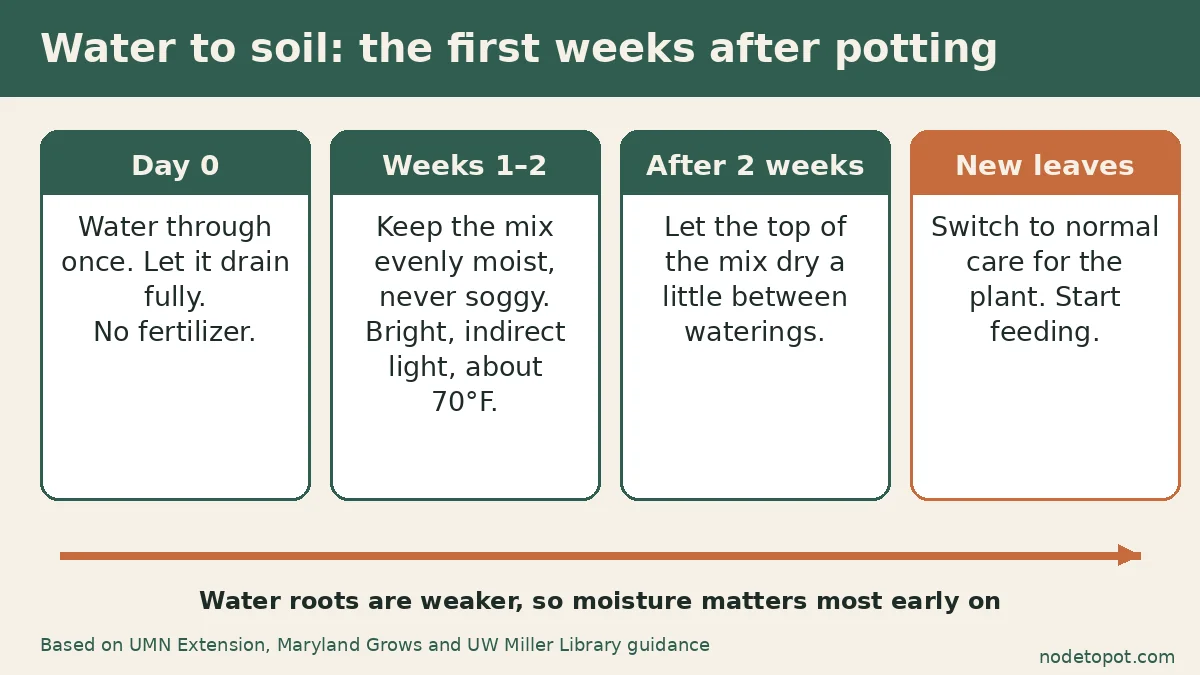
This is where most cuttings are won or lost. Extension guidance is consistent: keep the mix moist at first, then ease back.
| Stage | Watering | Light and warmth | Feeding |
|---|---|---|---|
| Day 0 | Water through once, let drain | Bright, indirect; out of harsh direct sun | None |
| Weeks 1–2 | Keep the mix evenly moist, not soggy | About 70°F; a heat mat helps in a cold room | None |
| After 2 weeks | Let the top of the mix dry slightly between waterings | Same spot; avoid moving it around | None yet |
| New growth appears | Shift to the plant’s normal routine | Normal care for the species | Begin feeding as the plant needs |
The table draws on three sources. UMN advises keeping the soil moist for the first 1–2 weeks after potting a water-rooted cutting, because water roots are weaker. The Miller Library recommends no fertilizer at first. UMN also notes that new leaves on monstera cuttings can take 2–3 months, so a quiet few weeks after potting is not a sign of failure.
Any watering schedule is a starting point. A pothos in a warm, bright room dries faster than a monstera cutting in a cool one, so check the mix with a finger before you water.
What about the gradual “soil in the jar” method?
Many shops and blogs suggest adding a little soil to the propagation jar every few days, so the cutting moves from water to mud to soil gradually. It sounds gentle and is widely repeated.
We could not find a university extension service, botanical garden or the RHS recommending it. The institutional guidance we read describes potting directly into a moist, free-draining mix. Our concern is practical: a jar has no drainage, and wet, compacted soil in a closed container is close to the conditions that encourage rot. That is reasoning, not a test result, so we suggest the direct method the sources describe.
Troubleshooting after potting
| Problem | Likely cause | What to try |
|---|---|---|
| Leaves droop in the first few days | Transplant shock; weak water roots not yet taking up enough water | Keep the mix evenly moist and the plant out of harsh sun |
| Mix stays wet for a week or more | Pot too big or mix too dense | Repot into a smaller pot or a more open mix |
| Stem turns soft at the soil line | Rot, usually from mix that stays too wet | Unpot and inspect; see the problems hub |
| No new growth after several weeks | Often normal; UMN notes monstera can take 2–3 months to form new leaves | Keep conditions steady and check roots gently before assuming failure |
Two common slow starters have their own guides: pothos cuttings with roots but no new leaves and monstera cuttings rotting in water.
FAQ
Can you put water-rooted cuttings straight into soil?
Yes. The extension and botanical garden guidance we use describes potting water-rooted cuttings directly into a moist, free-draining mix. The key is keeping that mix evenly moist for the first one to two weeks.
Are water roots and soil roots the same?
Not quite. University of Minnesota Extension describes roots grown in water as weaker, and Virginia Tech notes they suffer more transplant shock. That is why the first weeks after potting need careful watering.
How long should roots be before moving a cutting to soil?
About 1–2 inches, per UW’s Miller Library. Maryland Grows suggests letting roots grow another week or two after they first appear, then planting.
Should I fertilize a cutting right after potting?
No. The Miller Library recommends no fertilizer at first. Start feeding once the plant is putting out new growth.
Keep reading
- Water vs. soil propagation: which to choose
- How to propagate in sphagnum moss
- Going the other way: how to convert soil roots to water roots
- How we research these guides: our editorial standards