A monstera cutting rotting in water usually shows up as a brown, mushy end on the stem. It’s one of the most common propagation problems, and one of the most fixable. If the node is still firm, you can usually cut away the rot and restart. If the node itself has gone soft, that piece is finished, but the rest of the cutting may not be.
This guide shows how to tell real rot from harmless browning, what usually causes it, and a step-by-step rescue based on extension and botanical garden guidance. It sits in our cutting and root problems hub, alongside other propagation fixes. If you want to know where our advice comes from, read how we research and write our guides.
Short version: Monstera cuttings rot in water because the cut end sits constantly wet, bacteria build up in water that isn’t changed often enough, or the cutting has no node to root from. Cut back to firm tissue, restart in a clean jar with fresh water changed at least twice a week, or move the cutting to perlite or moist potting mix.
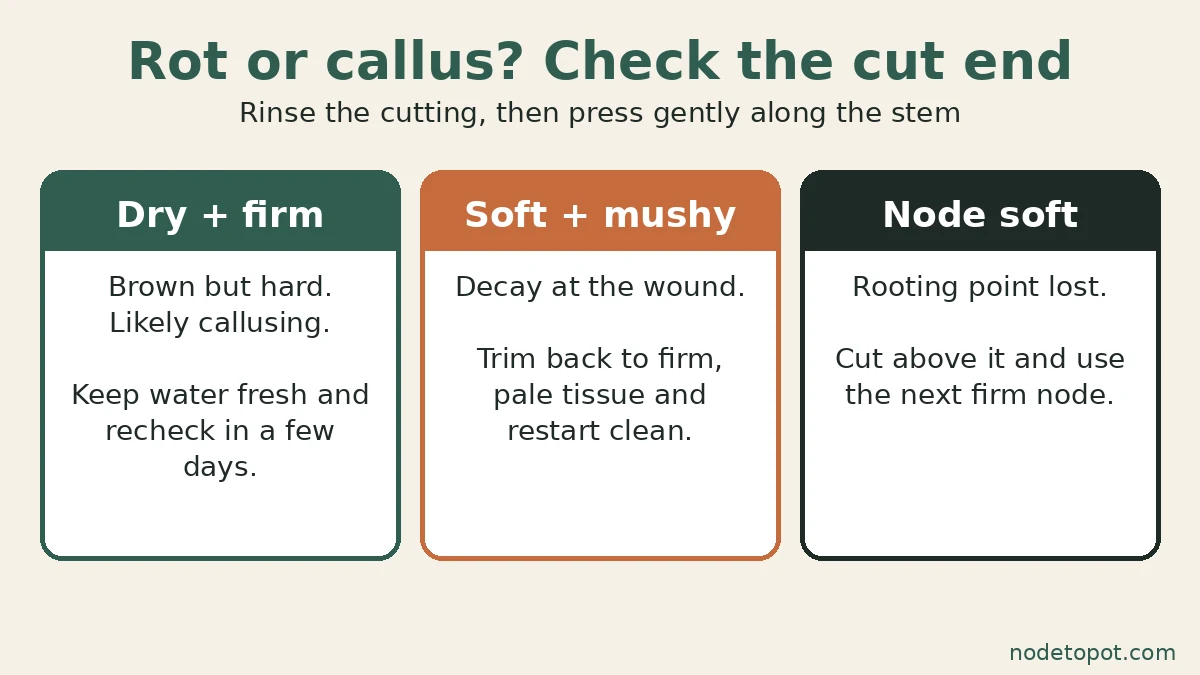
First, check: is it actually rot?
Not every color change is rot. Pull the cutting out, rinse it, and look closely.
| What you see | What it likely means | What to do |
|---|---|---|
| Cut end slightly brown but dry and firm | Likely the wound callusing over rather than rot, though we haven’t found a source that confirms it | Leave it, keep the water fresh, and recheck in a few days; if it softens, treat it as rot |
| Cut end brown, soft or mushy | Decay starting at the wound | Trim back to firm tissue (rescue plan below) |
| New roots creamy white and firm | Healthy roots | No action needed |
| New roots brown and soft | Root rot | Trim the bad roots; change medium or water routine |
| Node soft, dark or hollow when squeezed | The rooting point is lost | Discard that section; check for another node higher up |
| Cloudy water, slime on the glass, sour smell | Bacterial buildup | Wash the jar, replace the water, inspect the stem |
| A leaf yellowing, stem and node firm | Not rot on its own | Check the stem and node; keep conditions steady |
The healthy-versus-rotten root description comes from University of Minnesota Extension, which says healthy monstera roots should be creamy white and firm, while brown, soft roots point to overwatering or poor drainage (UMN Extension).
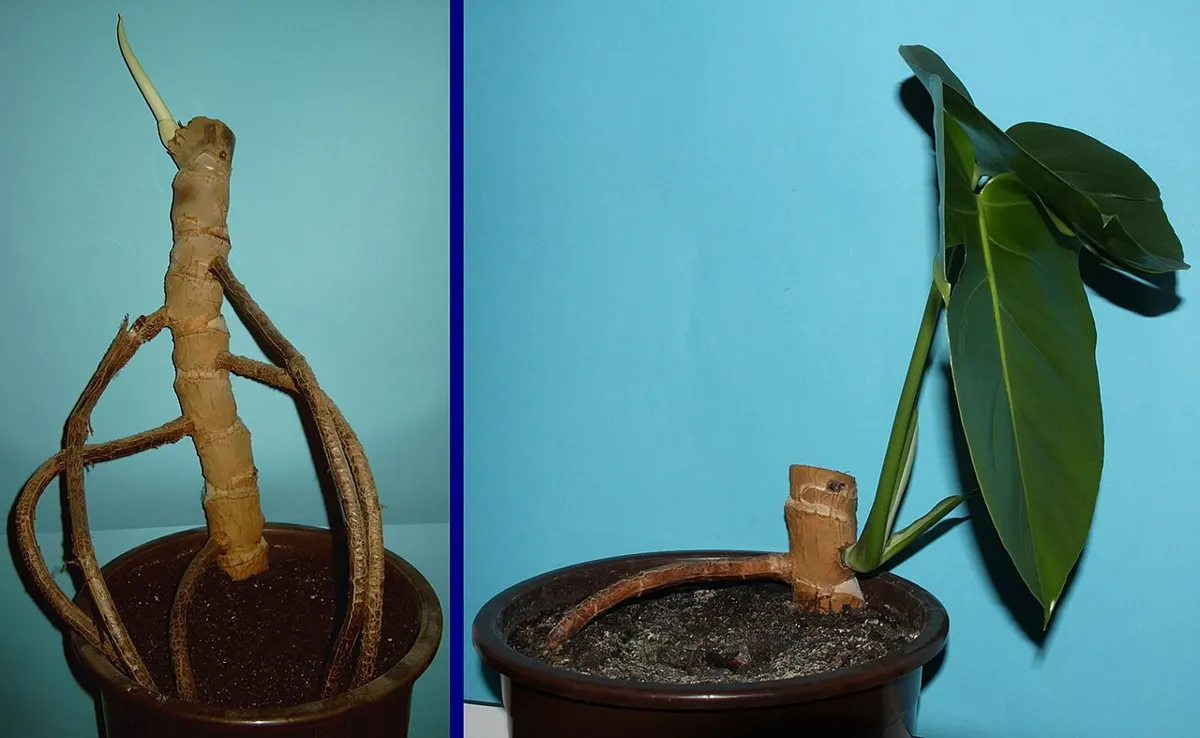
Why is my monstera cutting rotting in water?
1. The cut end is wet all the time
This is the simplest explanation and the most common one. Answering a reader whose monstera cuttings were turning brown at the tips, University of Maryland Extension’s Home and Garden Information Center said a cut end turning brown and mushy is common and suggests decay because it is constantly wet. They added that rooting in water carries a greater risk of infection at the stem cut than rooting in soil (Ask Extension).
2. The water isn’t changed often enough
Maryland Extension’s Maryland Grows blog advises changing the water periodically so it stays clean and provides oxygen, because bacterial growth in the water can lead to rotting. Their rule: change it at least twice a week, or whenever it starts to look cloudy (Maryland Grows). Virginia Cooperative Extension goes further: water that isn’t changed at least weekly becomes stagnant, oxygen deficient and inhibitory to rooting (Virginia Cooperative Extension).
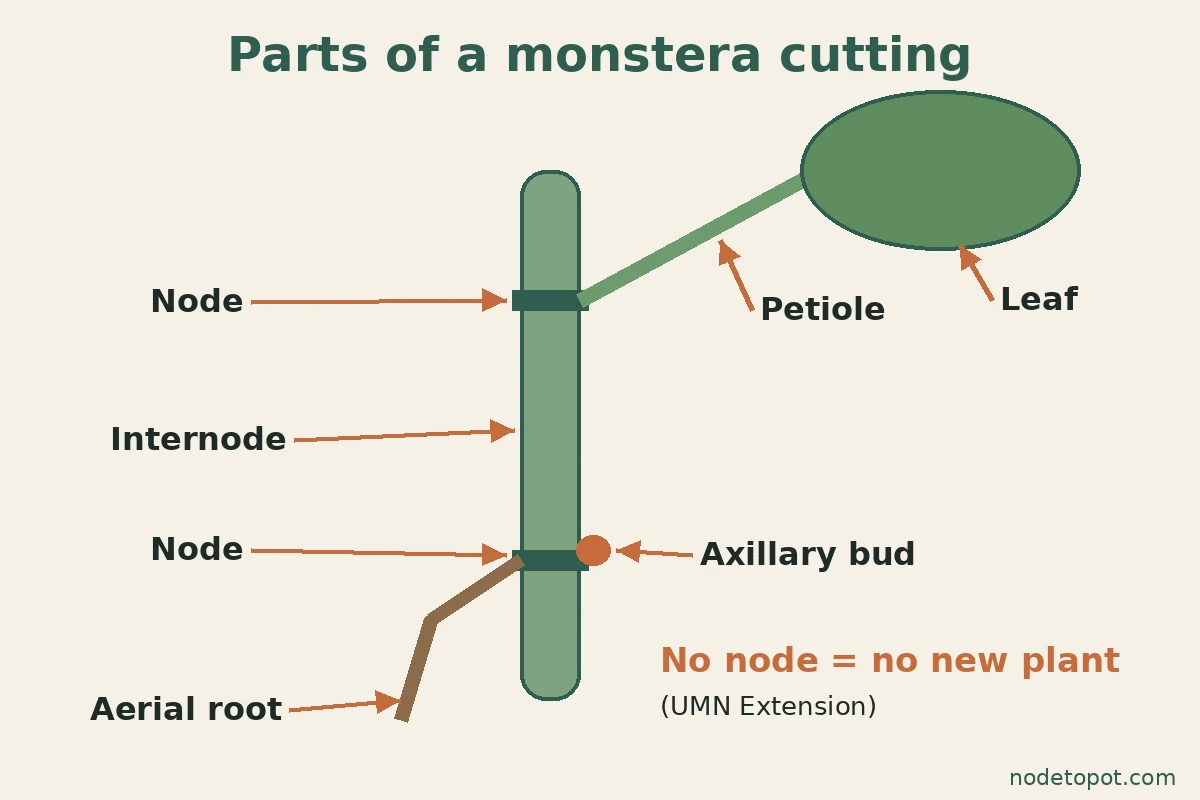
3. There’s no node
A leaf with a length of petiole looks like a cutting, but it can’t become a plant. UMN Extension is direct about this: monstera can only be propagated when the cutting includes a node, and cuttings without a node and axillary bud, such as leaves, won’t produce new growth and will ultimately rot.
If your “cutting” is a leaf and leaf stalk with no section of the main stem, it was never going to root into a new plant.
4. The stem is thick
Maryland Extension advises choosing cuttings with relatively thin stems because thicker stems can take longer to root and may rot before rooting. Monstera deliciosa stems are thick by houseplant standards, so a slow start in water is expected, and the longer the wait, the longer the wound sits wet. Missouri Botanical Garden makes a related point about woody plants: they usually rot in water rather than root (Missouri Botanical Garden).
5. Too much stem below the node
Our sources conflict here. UMN Extension’s monstera instructions say to cut 1–2 in (2.5–5 cm) below the node, along the internode (UMN Extension), although those steps are written for rooting media such as perlite rather than water. Missouri Botanical Garden’s guide to rooting cuttings in water says to cut just below the node, because a section of stem left below it often rots (Missouri Botanical Garden). Neither source looks at monstera in water specifically. If rot keeps starting on the stub under your node, trim the stub closer to the node, leaving a little firm tissue so you don’t cut into the node itself.
6. Leaves or petioles under water
Maryland Extension recommends that no leaves sit under the water. Submerged leaf tissue breaks down and feeds the same bacteria that attack the cut.
7. Conditions you can’t fully control
Maryland Extension’s experts are candid that they can’t predict which cuttings will rot in water. They list factors including water temperature, the cutting’s growth stage and vigor, and the microbes naturally present in your home. Some growers keep cuttings in water for long periods without trouble, and others lose the same plants (Ask Extension). If your cuttings rot repeatedly despite clean water, the medium may be the problem, not you.
Rescue plan: how to save a rotting monstera cutting
- Take it out and rinse it under room-temperature water so you can see the tissue clearly.
- Find where the rot ends. Press gently along the stem from the cut end upward. Rotten tissue is soft, discolored and may smell bad; healthy tissue is firm.
- Cut back into firm tissue with a clean, sharp blade. Make one clean cut rather than sawing.
- Check the node. If the node is firm, you’re in business. If the rot has reached it, cut above it and look for another node higher up. A section with no node won’t regrow, per UMN Extension.
- Trim any brown, soft roots back to firm, pale tissue.
- Wash the jar with hot, soapy water and rinse well. Starting a clean cutting in a dirty jar undoes the trim.
- Choose where it restarts (see the table below). If you go back to water, change it at least twice a week and whenever it clouds. Keep leaves out of the water.
- Put it somewhere warm and bright, out of direct sun and away from cold drafts. Maryland Extension puts the ideal room temperature for rooting at about 70°F (21°C).
Should you add rooting hormone or fertilizer?
Rooting hormone: optional. Maryland Extension notes it isn’t essential for many houseplants, including aroids like monstera. Its one benefit, in brands that include it, is a fungicide component that discourages stem rot until the wound callouses over (Ask Extension). Virginia Cooperative Extension likewise suggests a hormone preferably containing a fungicide, except for soft, fleshy stems (Virginia Cooperative Extension). UMN Extension says auxin can promote faster, denser rooting and can be added directly to water (UMN Extension). Follow the product label.
Fertilizer in the jar: skip it. Maryland Extension says liquid fertilizer is hard to dose correctly in water and may simply feed algae.
Water, perlite or soil for a rot-prone cutting?
If a cutting rotted once in water, switching medium is a reasonable next step. Maryland Extension’s advice to readers whose roots rot in water is to propagate in soil next time.
| Medium | Upside | Downside | Best for |
|---|---|---|---|
| Water | You can watch roots form; easy to set up | UMN notes water-grown roots are weaker; water must stay fresh | Cuttings with a firm node and an aerial root, when you’ll change water reliably |
| Perlite | UMN calls it the most common medium for monstera cuttings; gives support, oxygen and moisture | You can’t see roots without lifting the cutting | Cuttings that have already rotted once |
| Moist potting mix | Roots form in the medium they’ll grow in; Maryland Extension suggested it for a reader’s rotting cuttings | Too wet and cool invites damping off (UMN) | Cuttings you want to pot once and leave |
| LECA | UMN notes its drainage allows more frequent watering without raising damping-off risk | Costs more than other media (reusable) | Growers already using semi-hydro |
Whatever you choose, a top-heavy monstera cutting may need support. UMN suggests staking it until roots hold it upright, and Maryland Extension suggested pinning cuttings down into soil to anchor them. When you pot up, UMN recommends a container at least 4 in wide and 5 in deep.
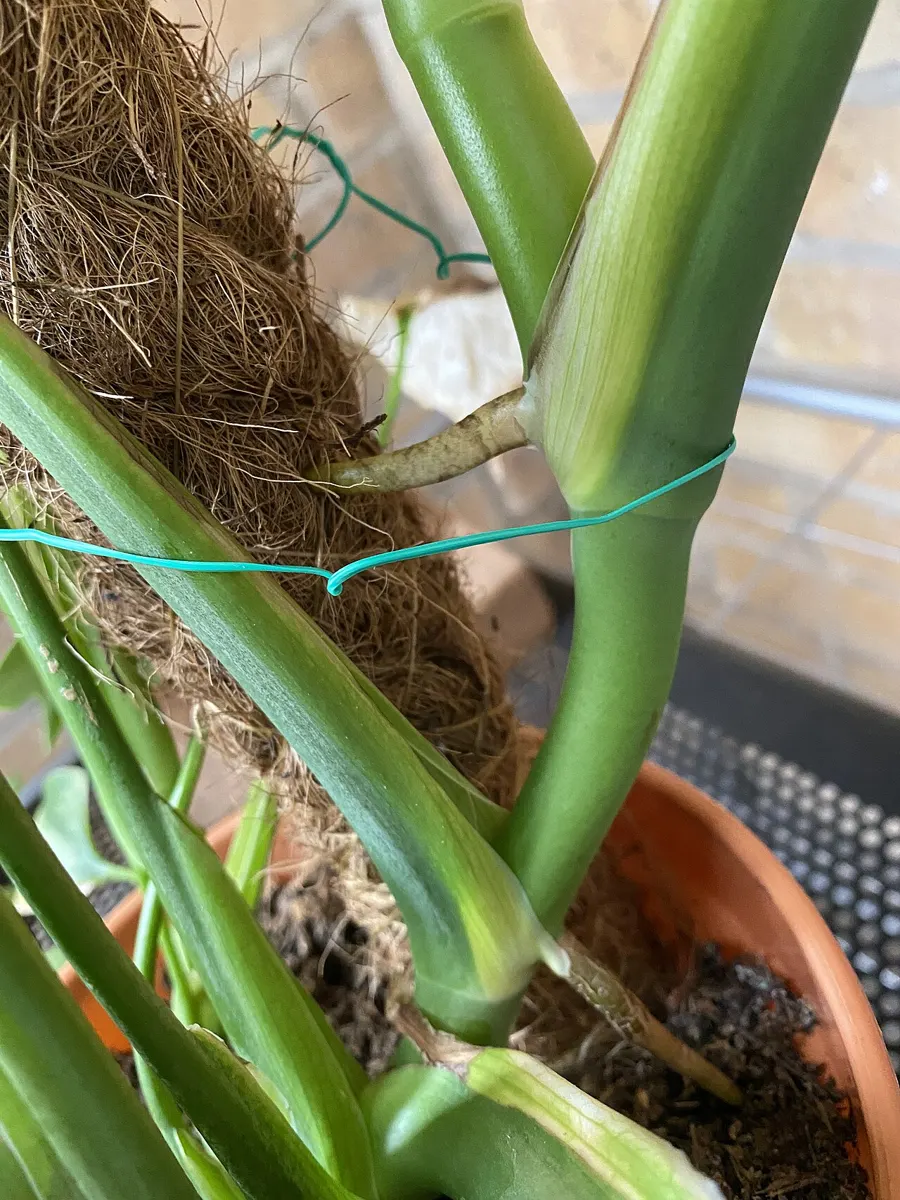
Planning to pot up later? Our guide to moving cuttings from water to soil covers the transition, and water vs soil propagation compares the two media using extension research. If you’d rather try a moss medium, see how to propagate in sphagnum moss.
How long should a monstera cutting take?
Slower than most people expect. UMN Extension says roots form in about 2–4 weeks in rooting media and that propagated nodes can take 2–3 months to form new leaves. Missouri Botanical Garden gives about 3–4 weeks for rooting in water and suggests potting once roots reach 1–2 in. Maryland Extension notes that root development in water may be slow.
A cutting that’s been in water for two weeks with no roots isn’t necessarily failing. A cutting that’s soft at the node is. If roots have formed but nothing is happening up top, the same patience applies; see why a cutting can have roots but no new leaves.
Prevention checklist
- Every cutting includes at least one node (UMN Extension).
- No leaves or petioles below the waterline (Maryland Extension).
- Water changed at least twice a week, or sooner if cloudy (Maryland Extension); never left longer than a week (Virginia Cooperative Extension).
- Clean jar at every restart.
- Bright, indirect light; about 70°F (21°C); no cold drafts (Maryland Extension).
- If a cutting has rotted once, root the next one in perlite or potting mix.
A note for pet owners
The ASPCA lists Monstera deliciosa as toxic to dogs and cats because it contains insoluble calcium oxalates. Signs include mouth irritation, drooling, vomiting and difficulty swallowing (ASPCA). Keep propagation jars where pets can’t knock them over or chew the leaves. If you think your pet has eaten part of the plant, contact your veterinarian or the ASPCA Animal Poison Control Center at (888) 426-4435 (a fee may apply).
FAQ
Can a rotting monstera cutting be saved?
Often, yes, as long as there is a firm node left. Cut back to healthy tissue and restart in fresh water or a well-draining medium such as perlite. If the node is soft, that section can’t grow a new plant.
Is a brown cut end always rot?
No. A cut end that is brown but dry and firm is likely the wound callusing over, though we have not found an extension source that confirms this for monstera. Soft, mushy or foul-smelling tissue is decay.
How often should I change the water for a monstera cutting?
Maryland Extension suggests at least twice a week, or whenever the water turns cloudy. Virginia Cooperative Extension warns that water left longer than a week becomes stagnant and low in oxygen.
How long can a monstera cutting stay in water?
There’s no fixed limit. Maryland Extension notes some growers keep cuttings in water for long periods while others see rot with the same plants. For a plant you want to keep long term, potting up once roots are established is the lower-risk route.
Should I use rooting hormone on a monstera cutting?
It’s optional. Maryland Extension says it isn’t essential for aroids like monstera, though a product that includes a fungicide can help discourage stem rot. Follow the label.