You can convert soil roots to water roots, moving a plant from potting mix into plain water, LECA or pon, but it is not just a change of pot. The roots that grew in soil are built for soil, and many of them will not survive the switch. What you are really doing is keeping the plant alive while it grows a new set of roots suited to wetter conditions. This guide covers how to do that with the least risk, using university extension guidance where it exists and clearly marking where it does not. If you are going the other way, from a water-rooted cutting into soil, see moving cuttings from water to soil. More guides on moving plants between water, soil and LECA are on the transitions hub.
Quick answer: Wash every trace of soil off the roots, cut away anything soft or dark, and set the plant so only part of the root system sits in water. Expect some old roots to die back (“root melt”) while new white roots form over the following weeks. Start with a healthy plant, not one you are trying to rescue.
Before you start: is this worth doing?
The RHS calls clay pebbles “tricky for beginners”, especially when moving a plant from soil to semi-hydro, because of the risk of root rot. That is the honest starting point. A soil-to-water conversion is a stress the plant has to grow through.
It tends to go best when:
- The plant is healthy and actively growing, not wilting, yellowing or recovering from rot.
- It is a vigorous species with fast-growing roots. Love That Leaf, a New Zealand plant-supply retailer, notes in its LECA guide that hardier plants with faster-growing roots adjust most easily.
- You can afford to lose it. A cheap or easily replaced plant is a better first attempt than a prized specimen.
If the plant is already sick, deal with that first. Our snake plant root rot triage guide walks through checking roots and deciding what can be saved. Converting a rotting plant to water usually makes things worse.
There is also a lower-risk route. Love That Leaf points out that some plants that struggle to move from soil do well if you take a cutting, root it in water and then move that to LECA, because the cutting already has water roots. Our guide to water vs soil propagation explains the trade-offs.
Why soil roots and water roots are different
Roots in soil grow in a mix of air pockets and damp particles. Roots that grow in water or a wet mineral medium develop differently. Nieuwkoop Europe, a Dutch supplier that converts potted plants to hydroculture commercially, says on its hydroculture guide that hydroculture roots are “less branched and have long, fine root hair”. That is a supplier’s description rather than a published study, but it explains why the old soil roots often fail and the plant replaces them.
The underlying problem is oxygen. Roots need air as well as water. Oregon State University Extension’s guide to deep water culture (EM 9455) describes systems where roots sit in the solution, and those systems use air pumps and air stones to keep the water oxygenated. A houseplant jar on a windowsill has none of that, so the water level has to do the job instead.
How to convert soil roots to water roots: step by step
Step 1: Choose your destination
- Plain water is the simplest to set up and lets you see every root, but the plant gets no support and no nutrients unless you add them. See our growing in water guides.
- LECA holds the plant upright and leaves large air gaps. See how to use LECA for preparing it.
- Pon has smaller grains and, in LECHUZA-PON, built-in fertilizer. See what pon substrate is, and LECA vs pon if you have not decided.
If you use LECA or pon, prepare it first. University of Minnesota Extension advises soaking hydroponic substrate in water for 24 hours and changing the water before planting. Love That Leaf adds that you should not pot into dry LECA, because it can pull water from the roots.
Step 2: Wash off all the soil
This is the step that decides most conversions. When transplanting into hydroponics, UMN says to “rinse the roots … to remove any remaining soil”. Love That Leaf, a retailer, goes further and advises removing as much organic matter as you can, including bark and moss. Leftover mix holds far more water than the surrounding LECA or water, keeping the roots around it permanently wet.
- Water the plant a day before, so the root ball is moist and easier to loosen.
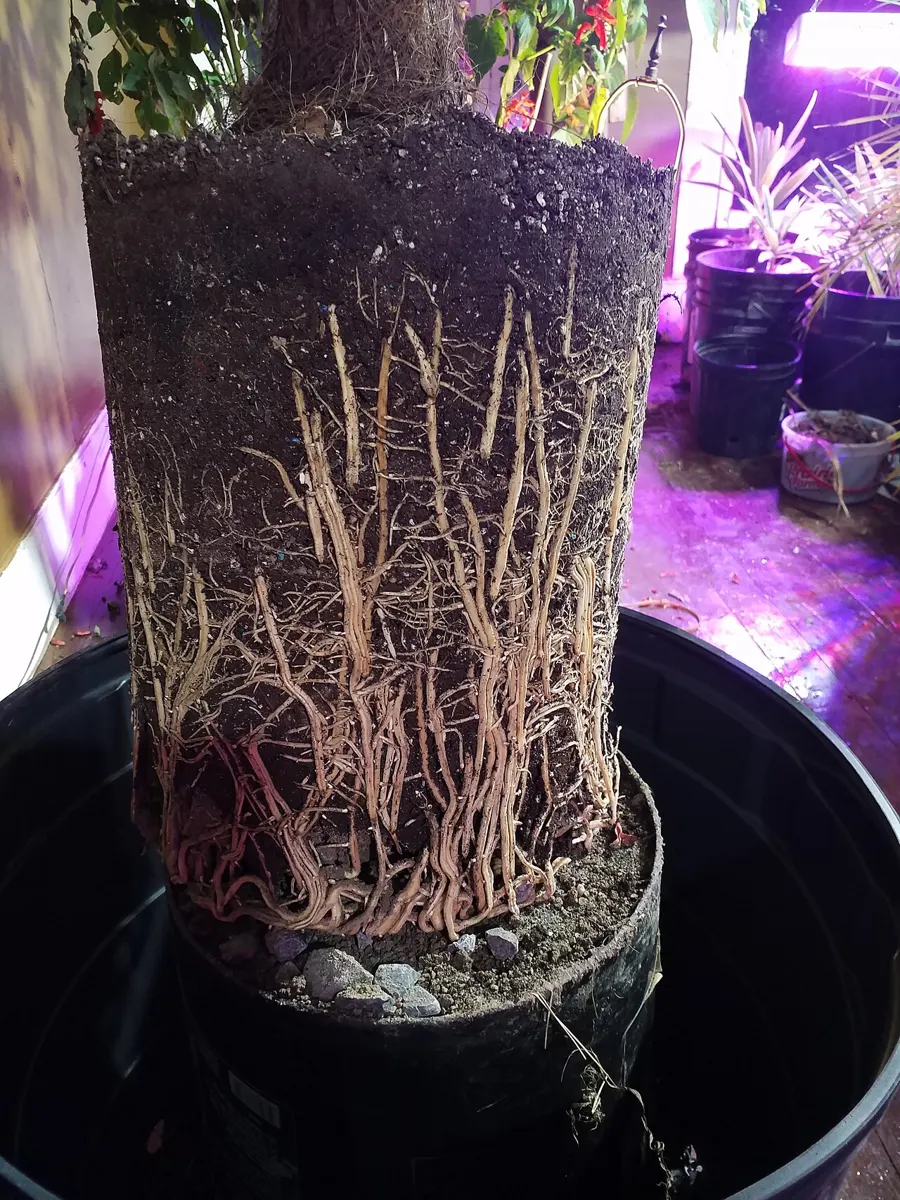
- Ease it out of the pot and crumble away as much mix as you can by hand.
- Rinse under lukewarm running water, or swish the roots in a bowl and change the water until it runs clear.
- Work fine roots apart gently. Fine root systems trap the most soil and take the longest.
Step 3: Trim damaged roots
With the roots clean, you can see what you are working with. Healthy roots are firm. Cut away anything soft, mushy, hollow or dark with clean scissors, and remove broken roots that are hanging by a thread. If a small section of root still has soil you cannot remove, cutting that section off is safer than leaving it. Don’t strip the plant bare to be safe. It needs its remaining roots to keep the leaves supplied while new ones form.
Step 4: Set the water level
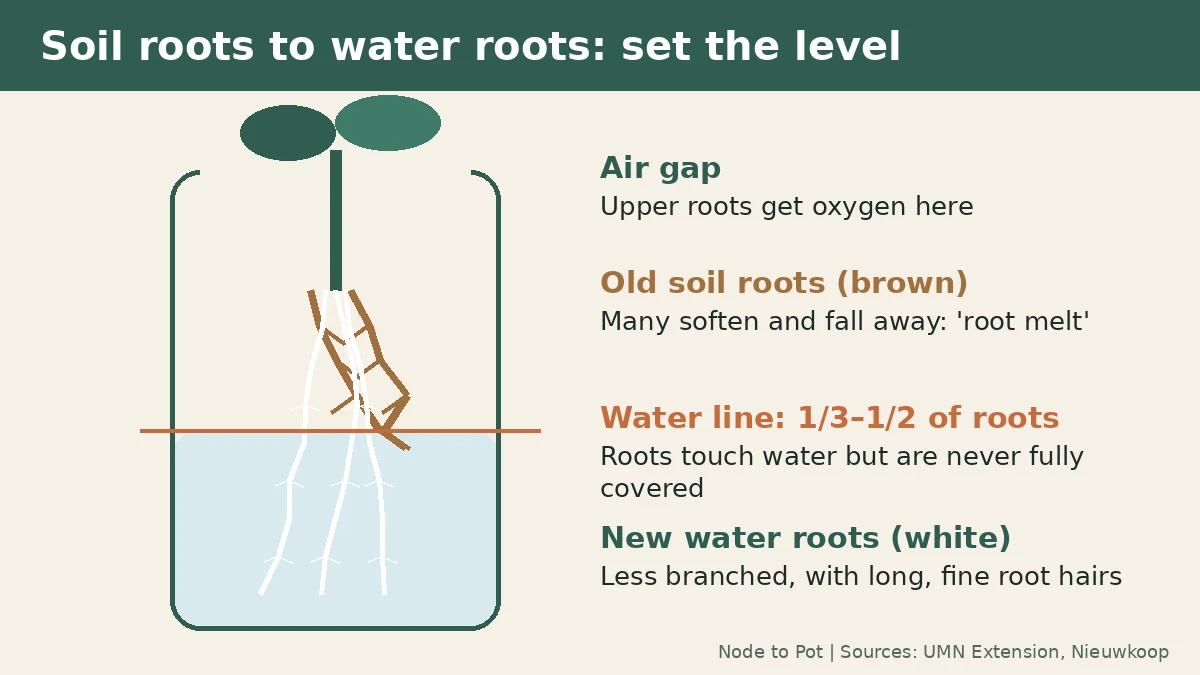
Do not submerge the whole root system. UMN’s guidance for passive hydroponic setups is to keep roots about one-third to one-half submerged; they “should not be fully immersed”. That way the upper roots get oxygen from the air gap. UMN also warns that too much water stops roots getting oxygen and can lead to root rot.
- In a jar of water: fill only partway up the roots, not to the stem.
- In LECA or pon: keep the reservoir low so the bottom of the roots reaches it and the rest sits in damp grains above.
- Use an opaque container or cover, which helps limit algae.
Nieuwkoop’s hydroculture brochure recommends a similar idea for established plants: once the water gauge reaches its minimum mark, wait 4–5 more days before refilling, so the roots do not stand in water all the time. That is a supplier’s routine for its own system rather than advice for jars, but it shows the same principle: roots need drier spells as well as wet ones.
What to expect: root melt and new water roots
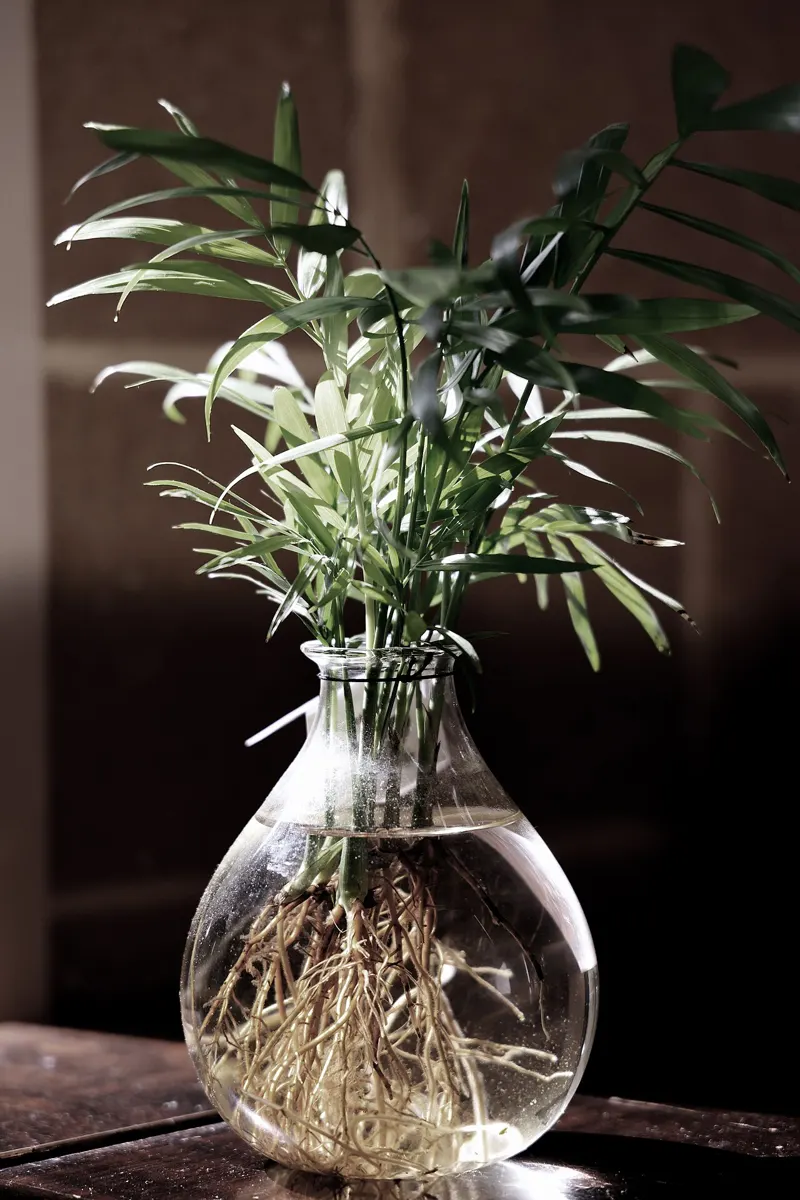
In the first few weeks, some of the old roots will probably go soft and translucent and fall away. Growers call this “root melt”, and Love That Leaf describes it as part of normal transplant shock when moving from soil. You may also see a lower leaf yellow. Neither is a reason to panic. What matters is whether new roots appear: usually white and fresh-looking, often growing from the older roots or the base of the stem.
Pull out melted roots as they loosen so they do not foul the water, and refresh the water if it clouds or smells. The RHS hydroponics guide warns that “roots of most plants will die in stagnant water.”
How long new roots take depends on the species, temperature and light, and we have not found a reliable published timeline for houseplants. Warmth helps: UMN says hydroponic solutions are ideally kept above 65°F (about 18°C). Judge progress by new white roots rather than the calendar.
Root melt vs root rot: know the difference
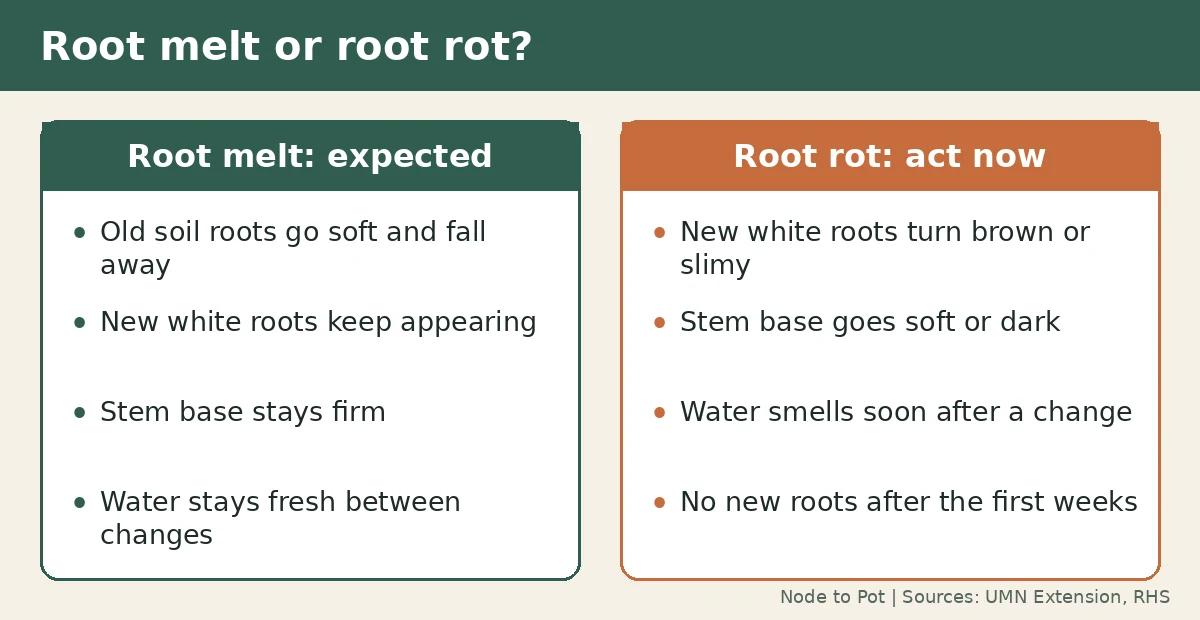
Melting soil roots are expected. Spreading rot is not. In hydroponic systems, a common cause of root rot is Pythium, a water mold, and UMN lists root rots among the most common problems in hydroponic growing. Signs that you have rot, not just melt:
- New white roots turn brown or slimy too, not just the old ones.
- The base of the stem goes soft or dark.
- The water smells bad soon after a change.
- The plant keeps declining past the first few weeks with no new roots.
If you see these, take the plant out, cut back to firm tissue, clean the container and lower the water level. UMN’s prevention advice for hydroponics is clean containers and tools, warmth, good airflow and not overfilling. Hobby guides often suggest hydrogen peroxide here. We are not aware of extension or RHS guidance that supports dosing houseplant water with it, so we don’t recommend it as a fix. For a cutting that is already decaying, see monstera cutting rotting in water.
Can you do it gradually?
A popular idea online is to ease the plant across: keep it in wetter and wetter soil, or mix soil and water together, so the roots adapt slowly. We have not found any extension or RHS source that tests or recommends a gradual method for houseplants. Leftover soil is also exactly what the sources above say to remove before moving a plant into water or LECA, so mixing the two carries a real risk of rot. Until there is better evidence, the direct wash-and-move method, or rooting a fresh cutting in water, is the better-supported route.
Feeding after the move
Plain water and LECA contain no nutrients; Oklahoma State Extension says expanded clay releases almost no nutrients. So the plant needs a fertilizer once it is settled. A cautious approach is to hold off or feed very weakly until new roots appear, then use a complete hydroponic fertilizer at the label rate or below, and check the pH. The RHS gives 5.8–6.2 as the usual hydroponic target, and UMN a wider 5.4–7. Fertilized pon already contains feed, so don’t add more at first. Our LECA vs pon comparison covers how long that lasts. When you change the water, don’t pour old nutrient solution down the drain; UMN suggests using it on other plants.
Our guides are built from extension, RHS and supplier sources, cited inline; read how we research and write our guides.
FAQ
Will my plant’s soil roots survive in water?
Some may, but many won’t. Expect a share of the old roots to die back while new ones form. The plant survives on the roots it keeps plus the new ones it grows.
How long does it take to grow water roots?
It varies by species, temperature and light, and there is no reliable published timeline for houseplants. Keep the plant warm, ideally above 65°F, and watch for new white roots.
Is water or LECA easier for a first conversion?
Neither is risk-free. Water lets you watch the roots closely, while LECA supports the plant and leaves more air around the roots. Either way, cleaning the roots well and keeping the water level low matter more than the choice.
Should I convert a plant with root rot to water to save it?
Usually not. Treat the rot first and let the plant recover in its usual medium. A conversion adds stress to a plant that is already struggling.