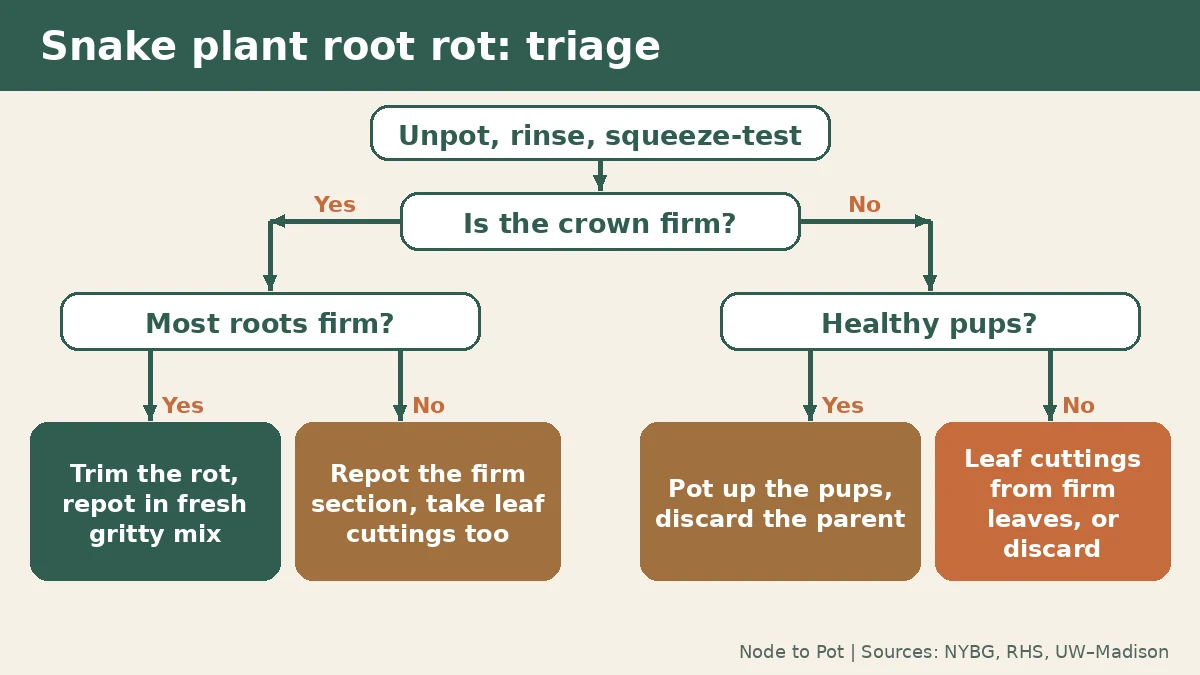
Snake plant root rot can often be stopped, but whether the plant can be saved depends on how far the rot has spread, and a ten-minute check with the plant out of its pot will tell you. If the crown is firm and some roots are healthy, you have a real chance. If the crown is soft or smells, the parent is usually lost, but you can often rescue part of it.
This triage guide covers that check, what to do at each level of damage, and how to prevent it. It’s part of our cutting and root problems hub.
Short version: Unpot the plant and rinse the roots. Healthy roots and rhizomes are firm; rotten ones are soft, brown and may smell. If only some roots are affected, cut them away and repot into a snug pot of fresh, fast-draining cactus mix. If the crown is soft or smelly, or nearly all the roots are gone, save any healthy pups or firm leaf sections and discard the rest.
Is it really snake plant root rot?
Snake plants are now classified by Kew’s Plants of the World Online as Dracaena trifasciata; Sansevieria trifasciata, the name still on most plant tags, is listed as a synonym (POWO). Whatever the label says, root rot tends to show up above the soil before you see the roots. Watch for:
- Leaves that are soft or collapsing, especially at the base.
- A plant that leans or wobbles. The RHS says a well-rooted sansevieria should sit firmly in its pot without wobbling much, and that if the whole plant leans, rather than a single leaf flopping, you should check for root rot (RHS).
- Wilting even though the soil is wet, plus stunting and yellowing. University of Wisconsin–Madison’s Plant Disease Diagnostics Clinic lists these as common signs of root rot in houseplants, with roots that are soft, brown and may smell bad (UW–Madison).
One look-alike is worth ruling out. The RHS notes that vine weevil grubs feed on sansevieria roots and can cause the leaves to collapse. Its vine weevil guide describes the grubs as plump, C-shaped, white and legless, with light brown heads, up to 10 mm (about 3/8 in) long (RHS). If you find them among the roots, you’re dealing with a pest as well as, or instead of, rot.
The 10-minute check
- Put on gloves. The RHS notes sansevieria sap can irritate skin.
- Ease the plant out of its pot. If it lifts out with almost no resistance, many roots are already gone.
- Wash the soil away. The New York Botanical Garden’s plant information service recommends gently brushing or spraying the soil off with tepid water so you can see the roots (NYBG).
- Squeeze-test everything. Work through the roots, the rhizomes (the thick underground stems that connect the leaves) and the base of each leaf. Healthy tissue is firm. Rotten tissue is soft, brown or slimy, and may smell.
- Estimate how much is affected and use the triage table below.
Triage: what you found and what to do
| What you found | Outlook | What to do |
|---|---|---|
| A few soft roots; most roots and all rhizomes firm; crown firm | Good | Cut out the rot and repot (rescue steps below) |
| Many roots soft, but a firm rhizome section with healthy leaves and some firm roots | Uncertain | Cut back to firm tissue, repot the healthy section on its own, and take leaf cuttings as a backup |
| All or most of the root mass rotten | Poor | NYBG says the plant is highly unlikely to recover; save pups or firm leaves instead |
| Crown above the soil soft or smelly | Poor for the parent | NYBG advises disposing of the plant at this point; salvage any healthy, separate pups first |
| Healthy pups with their own unaffected roots | Good for the pups | Separate and pot them on their own; NYBG suggests this as a way to start a new generation |
| No firm roots or rhizome left, but some leaves are firm | Leaf cuttings only | Take leaf cuttings from the firmest leaves (see below) |
UW–Madison is frank that throwing out a plant with root rot is often the most cost-effective choice. For a cheap, replaceable plant, that’s a legitimate decision. For a favorite, the steps below give it the best chance.
How to treat a snake plant with root rot
- Sterilize your blade. UW–Madison recommends disinfesting tools after working with root-rotted plants using a 10% bleach solution, a detergent solution, or alcohol.
- Cut away rotten roots and tissue. NYBG advises cutting affected roots off above the rotted segment with a sterilized knife, so only healthy root remains. Remove soft rhizome sections and any leaves rotting at the base. Clean the blade between cuts.
- Discard the old potting mix. UW–Madison advises against reusing potting mix from a plant with root rot, or the water that drained from it, since both can carry root rot organisms.
- Deal with the old pot. NYBG says to repot into a thoroughly sanitized container. UW–Madison goes further: clay pots can be disinfested, but plastic pots are hard to disinfest adequately and shouldn’t be reused after root rot. When in doubt, use a new pot.
- Choose a snug pot with drainage holes. NYBG recommends a container just large enough to hold the remaining roots, noting that snake plants like a tight pot. The RHS warns that an oversized pot holds extra compost that stays damp and encourages root rot.
- Use a fast-draining mix. NYBG recommends fresh, fast-draining succulent soil. The RHS suggests cactus compost, or a homemade mix of two parts loam-based compost to one part horticultural grit or fine gravel. Don’t add a layer of gravel at the bottom of the pot: UW–Madison says it can actually inhibit drainage.
- Replant at the same depth and firm the mix gently. If the plant is wobbly, support tall leaves with a cane until new roots anchor it, as the RHS suggests for new divisions.
- Water carefully. UW–Madison’s core advice for a plant with root rot is to reduce soil moisture: give enough water to meet the plant’s needs and prevent drought stress, but don’t overwater. The RHS says to water sansevierias only once the compost has dried out, avoid pouring into the center of the rosette, and empty any water that collects in the saucer.
None of these sources gives an exact day for the first watering after a root-rot repot. The safe reading of their advice is to start with fresh, barely damp mix, then water only when it has dried out, and lightly at first, because a trimmed root system can’t take up much.
What about fungicide, hydrogen peroxide or cinnamon?
UW–Madison does not recommend chemical fungicides for root rot on houseplants, because few products are available to home gardeners and those that are tend to be expensive. Hydrogen peroxide and cinnamon dips are popular online, but no extension service or RHS guidance supports either for snake plant root rot, so we don’t recommend them. Clean cuts, fresh mix and careful watering are what the sources back.
Saving a plant that’s too far gone: leaf cuttings
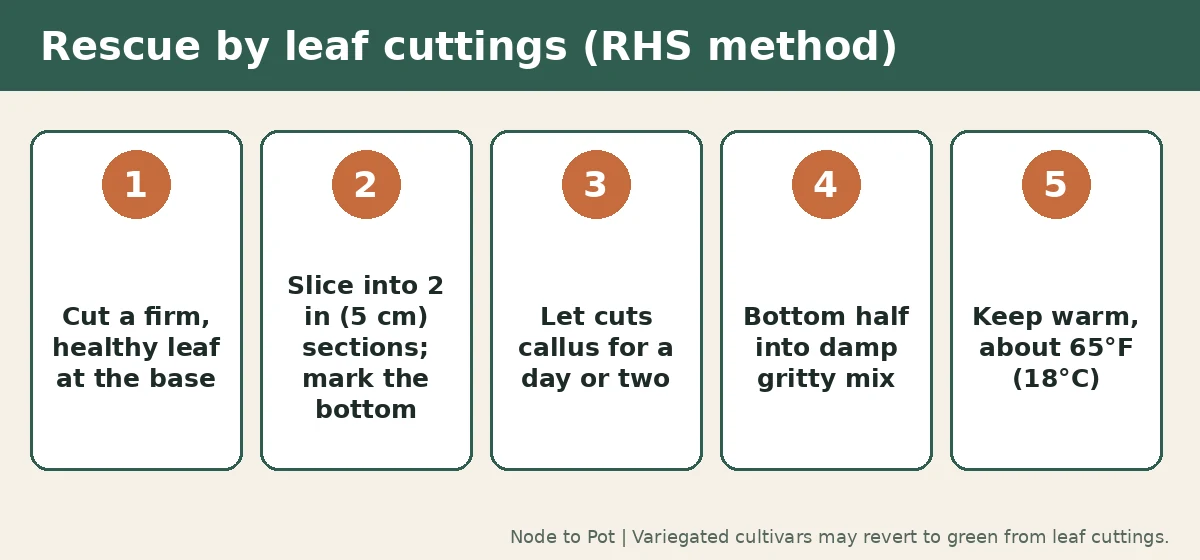
If no healthy roots or rhizome remain, firm leaves can still become new plants. The RHS method:
- Cut off a mature, healthy leaf at its base.
- Slice it widthways into sections about 2 in (5 cm) long, keeping each one the way up it grew. Mark the bottom edge so you don’t plant it upside down.
- Leave the sections in a dry place for a day or two so the cut surfaces callus over.
- Insert the bottom half of each section into a pot of damp, peat-free cuttings compost, or a 50:50 mix of loam-based compost and grit.
- Keep them in a propagator with bottom heat of about 65°F (18°C), or seal them inside a clear bag in a warm room.
The RHS recommends propagating in spring (March to May). Expect it to be slow.
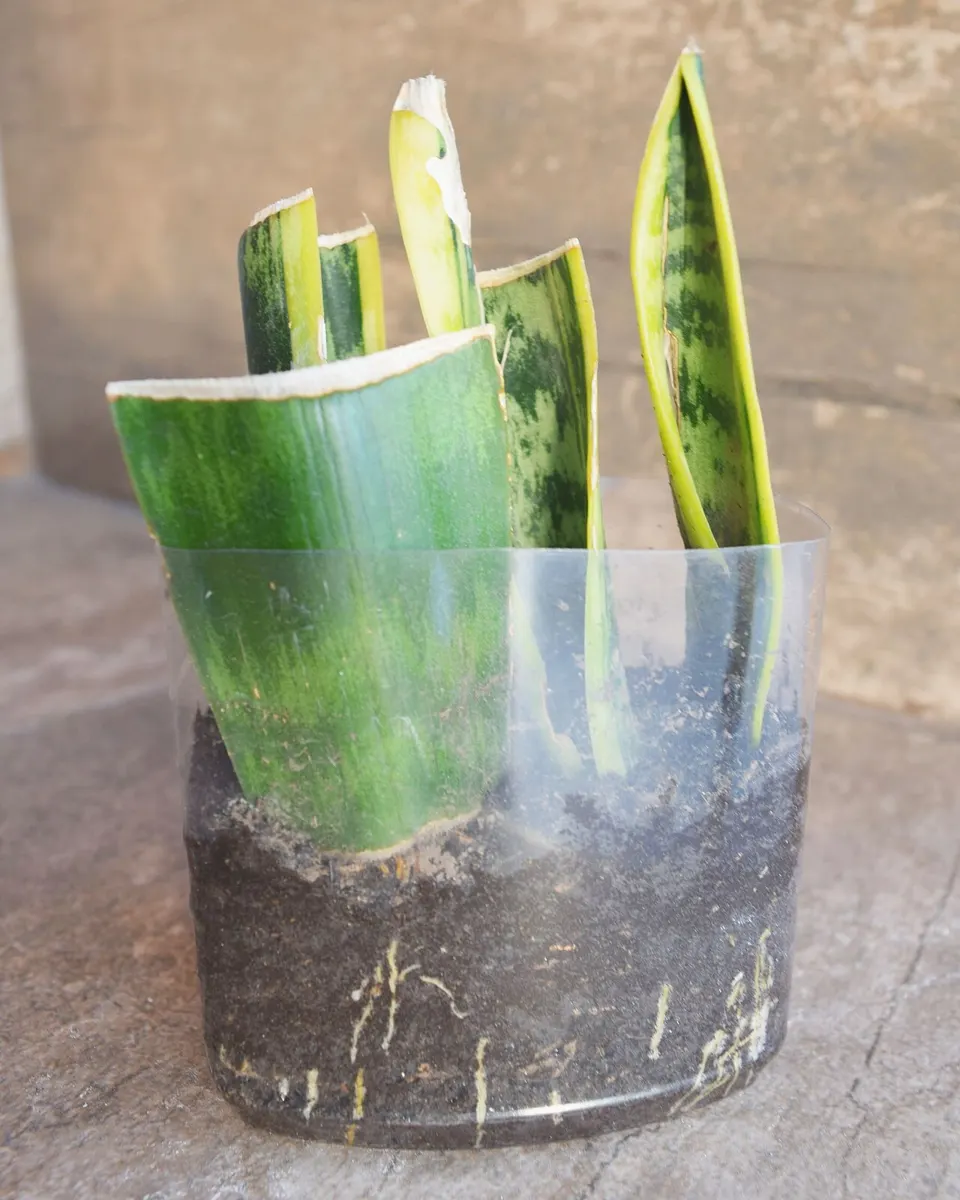
Variegated cultivars won’t come true from leaf cuttings. The RHS says cuttings from variegated cultivars tend to produce plants that revert to green. To keep a variegated plant’s pattern, save a firm section of rhizome with leaves and roots attached (a division) rather than relying on leaf cuttings.
Use only completely firm leaf sections; propagating soft tissue just moves the problem into a new pot. If you root sections in water instead, our guide to moving cuttings from water to soil covers the potting-up stage.
Why it happened, and how to stop it next time
NYBG lists the most common causes as overwatering, not reducing water in winter, a container that’s too large, and blocked drainage holes. The RHS adds leaving the plant standing in water.
| Cause | Prevention |
|---|---|
| Watering on a schedule | Water only when the mix has dried out; check with a finger first (RHS) |
| Winter watering | In winter, plants barely need water unless they’re in a particularly warm spot (RHS) |
| Pot too large | Repot only into a pot slightly larger than the last (RHS) |
| No drainage or blocked holes | Use pots with drainage holes; keep them clear (NYBG, RHS) |
| Standing water in saucer or outer pot | Empty it after watering (RHS); UW–Madison says not to let plants sit in drainage water |
| Garden soil or reused mix | Use fresh, pasteurized commercial potting mix, not garden soil (UW–Madison) |
The RHS gives a comfortable temperature range of about 60–75°F (15–24°C) and recommends keeping plants out of cold drafts.
Thinking of moving a recovering plant into semi-hydro later? Wait until it is firm and growing again, wash every trace of soil off the roots, and read our guides on how to use LECA and converting soil roots to water roots first. Semi-hydro changes how you water rather than removing the need for care.
Recovery: what to expect
Snake plants grow slowly, so a rescued plant can look unchanged for weeks. Judge progress by firmness, not new leaves. If it starts to wobble or soften again, unpot and check the roots. A new pup or leaf is the clearest sign that the roots have recovered.
Keep pets away from it
The ASPCA lists snake plant (mother-in-law’s tongue) as toxic to dogs and cats because it contains saponins, which can cause nausea, vomiting and diarrhea (ASPCA). Keep trimmed leaves and cuttings out of reach while you work. If you think a pet has eaten part of the plant, contact your veterinarian or the ASPCA Animal Poison Control Center at (888) 426-4435 (a fee may apply).
FAQ
Can you propagate a snake plant that has root rot?
Yes, from the healthy parts. Pot up healthy pups that have their own unaffected roots, or take leaf cuttings from firm leaves. Don’t propagate from any soft tissue.
Can root rot spread to my other plants?
The organisms that cause it can be carried in old potting mix, drainage water and on tools. UW–Madison advises not reusing either the mix or the drainage water and disinfesting tools, work surfaces and clay pots after handling a plant with root rot.
Should I use hydrogen peroxide on snake plant root rot?
No extension service or RHS guidance supports hydrogen peroxide or cinnamon for snake plant root rot. Trim to firm tissue, repot in fresh fast-draining mix and water sparingly.
Is a snake plant a Sansevieria or a Dracaena?
Kew’s Plants of the World Online accepts Dracaena trifasciata as the name and lists Sansevieria trifasciata as a synonym. Care is the same either way.