A pothos cutting with roots but no new leaves is one of the most common propagation worries, and it is usually not a failure. Roots and leaves come from different places on a cutting. Roots can form along the stem near a node, but a new leaf can only come from the bud at a node. If your cutting has no viable bud, it may root and never grow. Even with a good bud, roots often appear first. University of Florida IFAS reports that single-node pothos cuttings in commercial production break bud in 2–3 weeks and root in 3–4 weeks. Those figures come from warm, bright greenhouses, so a slower start in a living room is normal. This guide is part of our cutting and root problems hub.
Quick answer: First check that the cutting includes a piece of vine with a node, not just a leaf on its stalk. If it does, keep it warm (around 70–75°F / 21–24°C), give it bright indirect light and change the water regularly. Once the roots are 1–2 inches long, potting it up usually helps more than waiting longer in the jar.
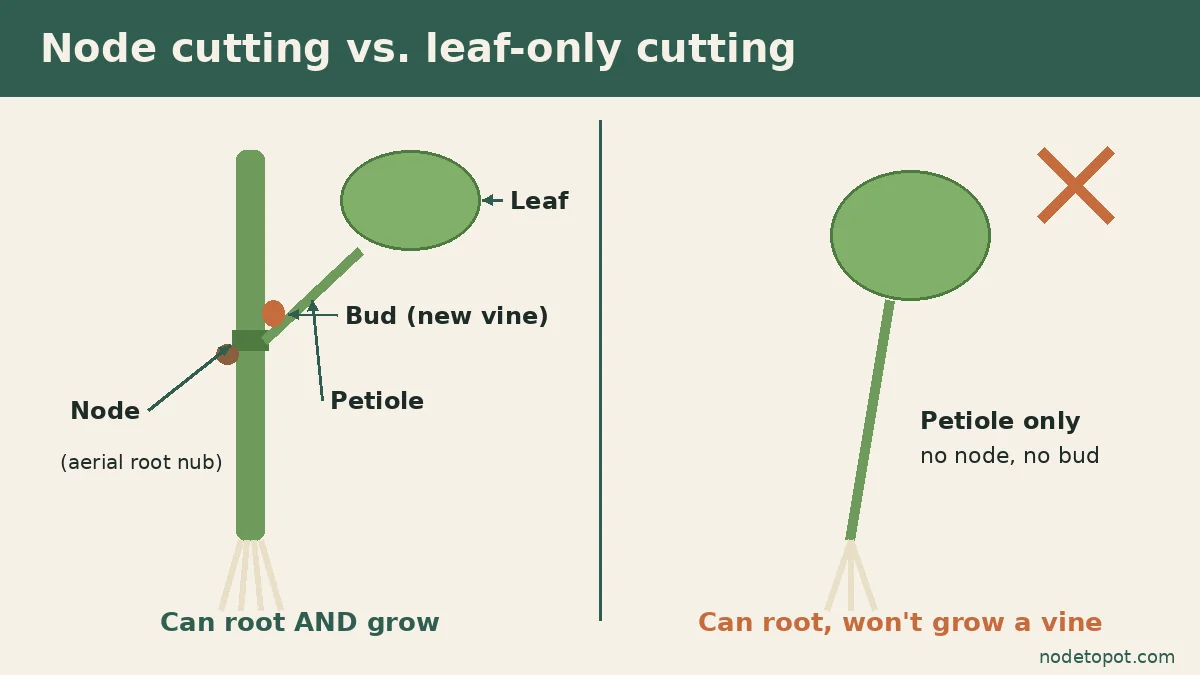
Step 1: Check what you actually cut
This is the most common dead end, and it takes thirty seconds to rule out.
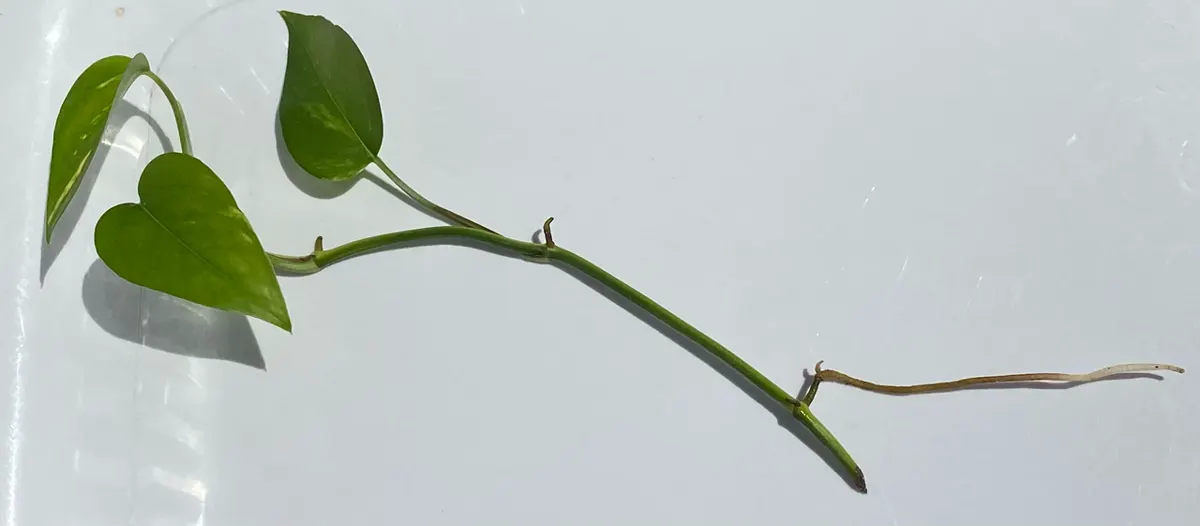
A pothos leaf joins the vine by a stalk called the petiole. Where the petiole meets the vine is the node, which often carries a small brown aerial-root bump. In the angle between petiole and vine sits the axillary bud, where a new vine starts. University of Minnesota Extension, writing about monstera (a close aroid relative), states the rule plainly: leaves and petioles won’t grow on their own, because new growth comes from axillary buds and nodes on the stem.
So look at the bottom of your cutting:
- There is a piece of vine with a node on it. Good. The cutting can grow. Keep reading.
- It is a leaf on its stalk with no vine at all. That is a leaf cutting. Virginia Tech‘s propagation guide notes that the leaves of most plants either produce a few roots but no plant, or simply decay. A rooted pothos leaf can stay green in water for a long time, but don’t expect a vine. Take a new cutting with at least one node.
Also check what is below the node. The Missouri Botanical Garden notes that a stub of stem left below the node often rots, so trim any long, soft section back toward the node before it fouls the water.
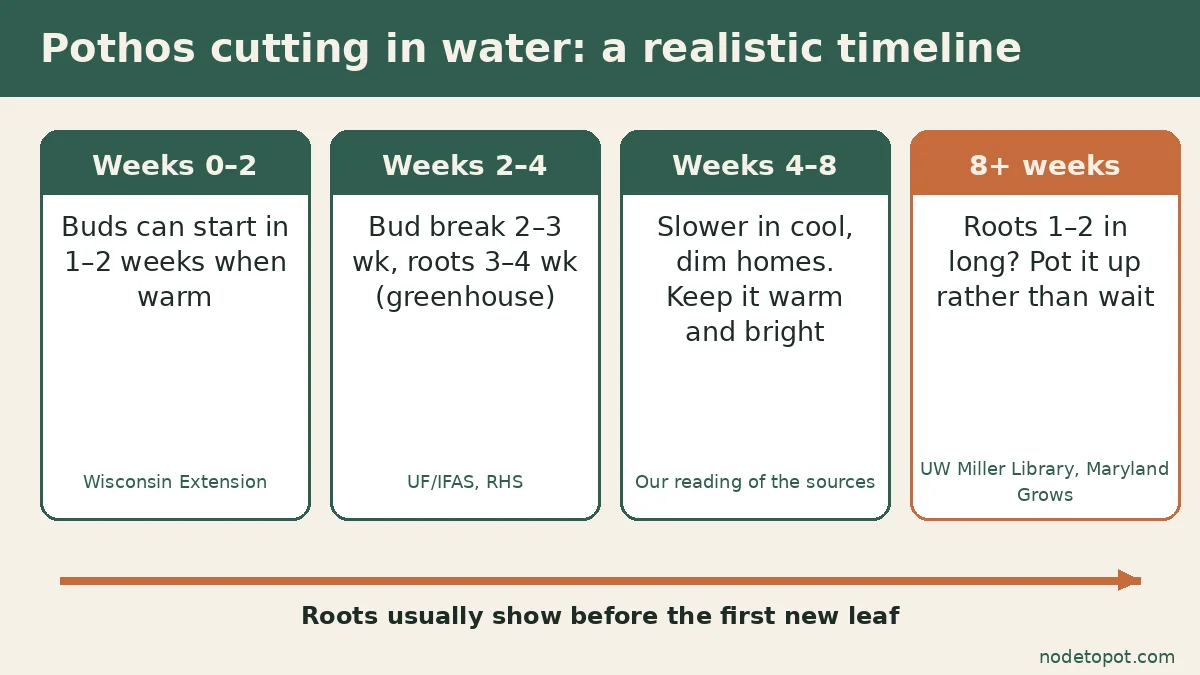
How long to wait: a realistic timeline
The figures below come from extension and horticultural sources. The “in a typical home” column is our reading of how those figures shift outside a greenhouse. Treat it as a guide for when to act, not as a measured result.
| Time since cutting | What the sources report | In a typical home | What to do |
|---|---|---|---|
| Weeks 0–2 | Wisconsin Extension: buds can start growing in 1–2 weeks when it is warm | Often nothing visible yet | Change the water, keep it warm and bright |
| Weeks 2–4 | UF/IFAS: bud break in 2–3 weeks, rooting in 3–4 weeks (commercial). RHS: cuttings root in 3–4 weeks | First roots are likely; the bud may not have moved | Keep going; make sure the node is clear of any rot |
| Weeks 4–8 | UMN: monstera cuttings can take 2–3 months to produce new leaves | Roots lengthen; the bud may start to swell | Fix any conditions in the next section |
| Roots 1–2 in long, still no bud | UW Botanic Gardens’ Miller Library (general cuttings advice): pot once roots are 1–2 inches | Waiting longer in water rarely helps | Pot it up and keep the mix moist |
Why a cutting with a node still won’t push a leaf
If there is a node, the bud is usually waiting on conditions. Work down this table:
| Clue | Likely cause | Fix | Source |
|---|---|---|---|
| Room drops below about 65°F (18°C) at night, or the jar sits on a cold windowsill | Too cool | Move it somewhere warmer. Virginia Tech recommends 70–75°F for rooting; the Miller Library suggests a heat mat | UF/IFAS: pothos growth slows when nights drop below 65°F |
| Jar sits across the room from a window, or in a dim corner | Too dark | Move it to bright, indirect light out of harsh direct sun. A grow light also works | UF/IFAS: in very low indoor light, pothos survives but new leaves stay small (an indoor-care figure, not a rooting figure) |
| Water is cloudy, or you change it “when you remember” | Stale, low-oxygen water | Change it at least weekly, and twice a week if you can | Virginia Tech: change water weekly. Maryland Grows: at least twice a week |
| Cutting taken in late autumn or winter | Seasonal slowdown | Patience, plus warmth and light | RHS: late spring to early summer, when the plant is in full growth, is the best time for cuttings |
| Single node with one small leaf | Little leaf area to fuel growth | It can still grow, just slowly. Next time, take a cutting with a few leaves | UMN (monstera): more leaves support rooting through photosynthesis |
| You added plant food to the jar | Fertilizer too early | Replace with plain water | Miller Library: no fertilizer at first |
| Roots brown, soft or smelly | Rot | Trim back to firm tissue and restart in fresh water, or take a new cutting | UMN: healthy roots are creamy white and firm |
What to do now, step by step
- Confirm the node. No node means starting over with a proper cutting.
- Check the roots. Firm and creamy white is healthy. Brown and mushy means trim and restart.
- Fix the environment. Warmth and bright indirect light are the two levers that most often unstick a bud.
- Refresh the water. Rinse the jar too, so the node sits in clean water. The Missouri Botanical Garden also suggests topping up with fresh water as it drops.
- Decide whether to pot up. University of Maryland Extension (Maryland Grows) advises letting roots grow another week or two once they appear, then planting. The Miller Library says to pot when roots are 1–2 inches long, in an open, free-draining mix. The RHS suggests a pot 8–10 cm (3–4 in) wide. A new leaf is not a requirement for potting.
- Keep the mix moist at first. UMN advises keeping the soil evenly moist for the first 1–2 weeks after potting a water-rooted cutting, because water roots are weaker than soil roots.
- Plant several together for a full pot. Wisconsin Extension recommends planting several rooted cuttings in one pot.
Moving water-grown roots into soil carries its own risk. Virginia Tech notes that roots formed in water suffer more transplant shock than roots formed in a solid medium. Our guide to moving cuttings from water to soil covers how to soften that step. If you’d rather skip the water stage next time, try propagating in sphagnum moss, or compare the options in water vs. soil propagation.
What not to do
- Don’t pull the cutting out every day to check. You risk breaking new roots and the bud.
- Don’t cut off healthy roots to “force” leaves. The roots are what will supply water to the new growth once the bud moves.
- Don’t add fertilizer to the jar. Wait until the plant is established in its pot.
- Don’t plan on leaving it in plain water for months. Under a University of Maryland Extension (Maryland Grows) post on rooting cuttings in water, a reply signed Christa describes keeping an office pothos in a jar of water for years: it “survived but it didn’t thrive.”
Yellowing leaves while you wait are a separate problem, usually linked to light, water quality or rot. Our problems hub covers those, and the plant guides cover pothos care beyond propagation.
Pothos cutting with roots but no new leaves: the short version
Check for a node. If it is there, give the cutting warmth, bright indirect light and clean water, and expect roots weeks before the first leaf. When roots reach 1–2 inches, pot it up in an open mix, keep it moist for the first couple of weeks, and let the bud move in its own time.
FAQ
Can a pothos leaf without a node grow into a new plant?
No. It may grow roots, but new vines come from the bud at a node, so a leaf on its stalk alone won’t produce one.
How long does it take a pothos cutting to grow a new leaf?
University of Florida reports bud break in about 2–3 weeks in commercial greenhouses, and Wisconsin Extension says buds can start in 1–2 weeks when warm. In homes it is often slower, especially in cool or dim rooms and in winter.
Should I pot up a cutting that hasn’t grown a leaf yet?
Yes, if it has a healthy node and roots 1–2 inches long. Keep the mix moist for the first 1–2 weeks after potting, and the new leaf often follows once it settles.
What temperature do pothos cuttings need?
Around 70–75°F (21–24°C) suits rooting. University of Florida notes pothos growth slows when nights fall below 65°F.