This page explains the editorial standards behind every Node to Pot guide: where our information comes from, how we check it, how we keep it current and how you can tell us when we get something wrong. Node to Pot is written by Akash, a houseplant grower based in Denver, Colorado. It is a small, independent site about propagating houseplants, and we want you to know exactly what kind of evidence sits behind the advice you read here.
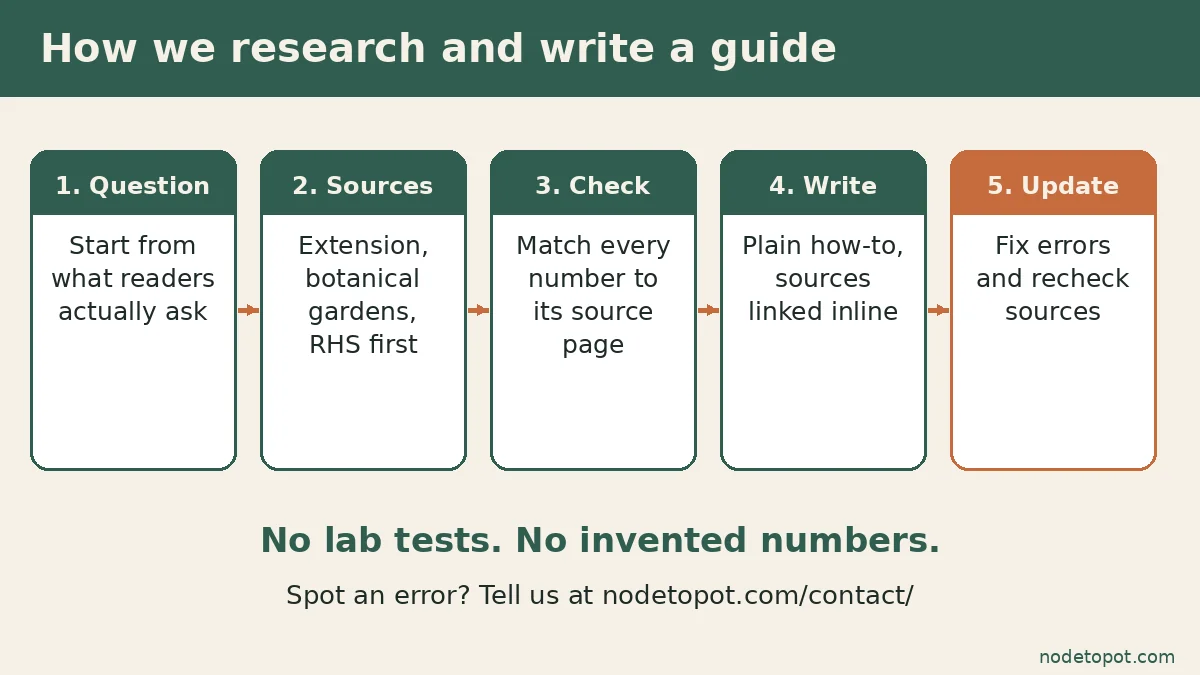
In one line: our guides are researched from university extension services, botanical gardens, the Royal Horticultural Society (RHS) and, where relevant, manufacturer documents that we label as such. We do not run lab tests, and we don’t publish test results, measurements or “we tried it” claims we can’t back up.
Our editorial standards in short
- Every factual claim has a source, linked in the text next to the claim, so you can read the original yourself.
- Numbers are copied from the source, not estimated. If a source gives a range, we give the same range.
- We say where a figure comes from. A greenhouse timing from a university study is labelled as such, because it may not match a cool living room.
- Manufacturer figures are labelled as the manufacturer’s. A claim on a product page stays the maker’s claim until an independent source confirms it.
- Our own reasoning is labelled as reasoning. When we interpret sources or suggest a rule of thumb, we say so.
- No invented experience. We don’t write “in our tests” or “we found” unless we actually did the thing and can show it.
The sources we use
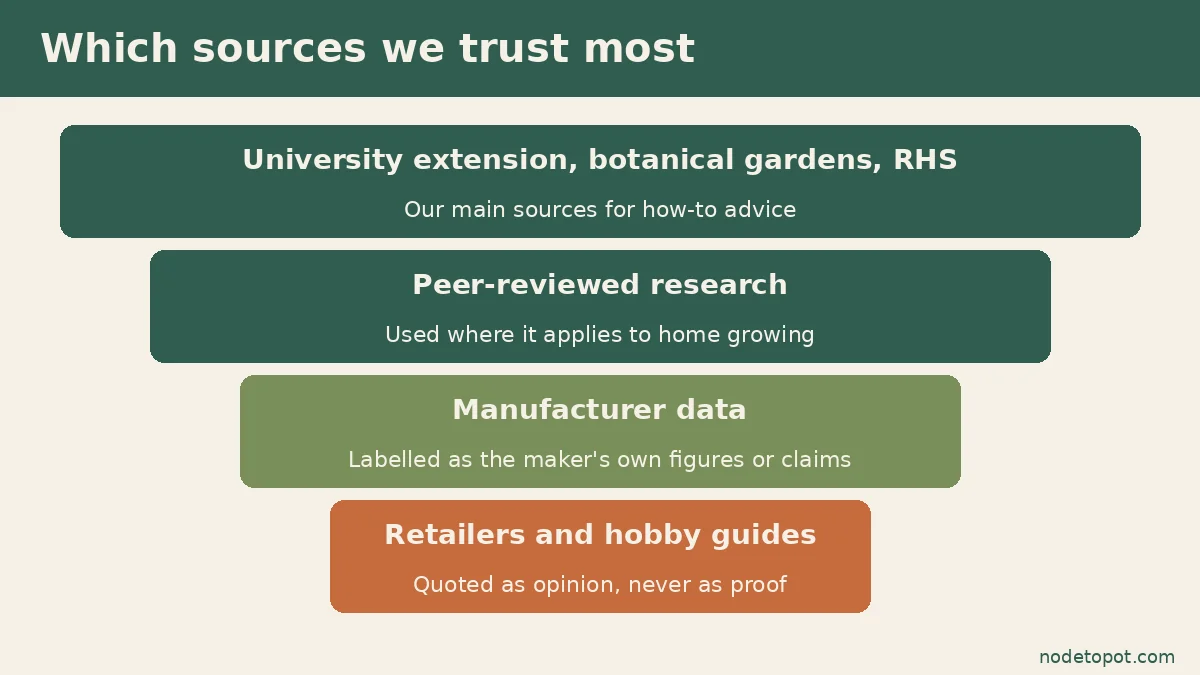
We rank sources by how independent and how specific they are. The higher a source sits in this list, the more weight it carries in a guide.
1. University extension services
Extension services are the public-outreach arms of universities, and their fact sheets are written for home growers. We rely on them most. Examples we cite include University of Florida IFAS, University of Minnesota Extension, Virginia Tech, Wisconsin Extension, University of Maryland Extension, Oklahoma State and University of Arizona.
2. Botanical gardens and horticultural societies
Public gardens answer home-grower questions every day. We use the Missouri Botanical Garden, the Elisabeth C. Miller Library at UW Botanic Gardens and the RHS. The RHS is British, so we convert its metric figures and note where UK timing or seasons differ from the US.
3. Peer-reviewed research
We use published studies where they apply to home growing. A study run on commercial crops or under greenhouse conditions is described that way, not presented as a promise for your windowsill.
4. Manufacturer data, labelled as manufacturer data
Some topics, like branded growing media, depend on what the maker publishes: ingredient declarations, particle sizes, fertilizer content and pH. We quote those documents directly and name them, for example “per Lechuza’s product declaration.” Marketing claims, such as a product preventing pests, are always marked as the company’s own claim.
5. Retailers and hobby guides
Shops and enthusiast blogs can be useful for practical tips, but they are not independent evidence. When we quote one, we name it and treat it as an opinion, never as proof.
How we check claims
- Read the source page itself. We don’t rely on a search snippet or another blog’s summary. A figure goes into a guide only after we have found it on the page we link.
- Match the wording. If a source says “about 70°F,” we don’t turn it into “exactly 70°F.” If it says something applies to monstera, we say monstera, even when the guide is about a related plant.
- Look for disagreement. Sources sometimes conflict, for example on how often to change propagation water or where to cut below a node. When they do, we show both positions and name who says what, rather than quietly picking one.
- Cut what can’t be confirmed. Widely repeated claims that we can’t trace to a reliable source are either left out or clearly marked as unconfirmed.
- Attribute quotes carefully. We only name a person if the source page shows their name, and we keep quotes short.
What we don’t do
- We don’t run lab tests or controlled experiments, and we don’t publish results tables, rooting rates or measurements of our own.
- We don’t publish product reviews or ratings based on testing we haven’t done.
- We don’t invent numbers, quotes or experiences to make a guide feel more personal.
- We don’t give medical, veterinary or safety advice. For questions about plant toxicity to pets or children, check with your vet, doctor or a poison control service.
If we ever run home trials in future, they will be described separately, with photos and the conditions they ran under, and clearly marked as small, informal observations rather than scientific results.
How we keep guides up to date
Each guide shows the date it was published and the date it was last updated. We revisit guides when:
- a reader reports an error or a broken link,
- a source we cite is revised, moved or withdrawn,
- a manufacturer changes a product’s formula or instructions, or
- we find a better or more specific source for a claim.
When a correction changes the advice in a guide, not just a typo, we update the “last updated” date and fix the text. We would rather correct a guide than leave a wrong number in place.
Corrections and feedback
If you spot a mistake, a broken link or a source that says something different from what we wrote, please tell us through our contact page. It helps to include the page address, the sentence in question and, if you have one, a link to the source you are relying on. We read every message and fix confirmed errors.
Independence and advertising
Node to Pot may show advertising to cover running costs. Advertisers do not choose topics, review guides before they publish or influence what we recommend. We are not paid by the brands or retailers we mention. If that ever changes, for example through affiliate links, we will disclose it clearly on the page where it applies.
Where to start
New to propagation? Try our water propagation hub, the semi-hydro hub for LECA and pon, or the problems hub if a cutting is misbehaving. A few guides built on the standards above:
- Why your pothos cutting has roots but no new leaves
- Moving cuttings from water to soil
- What is pon substrate?
- Water vs. soil propagation
To learn more about who writes Node to Pot, visit our About page.
FAQ
Do you test the methods you write about?
No. We don’t run lab tests or controlled experiments. Our guides are researched from university extension services, botanical gardens, the RHS and clearly labelled manufacturer documents.
Why do you link to so many sources?
So you can check every claim yourself. Each fact links to the page it came from, and figures are given as the source states them.
How do I report a mistake?
Use our contact page at /contact/. Include the page address, the sentence in question and, if possible, a link to your source. We fix confirmed errors and update the page date.
Are brands paying for mentions?
No. We are not paid by the brands or retailers we mention. If we ever add affiliate links, we will disclose them on the page.